
Elastomeric bearing pads are essential components in bridge construction, serving as the interface between the superstructure and substructure. Their primary functions are to transfer vertical loads, accommodate translational movements resulting from temperature variation, creep, shrinkage, and live loads, and permit rotational movements between the superstructure and substructure.
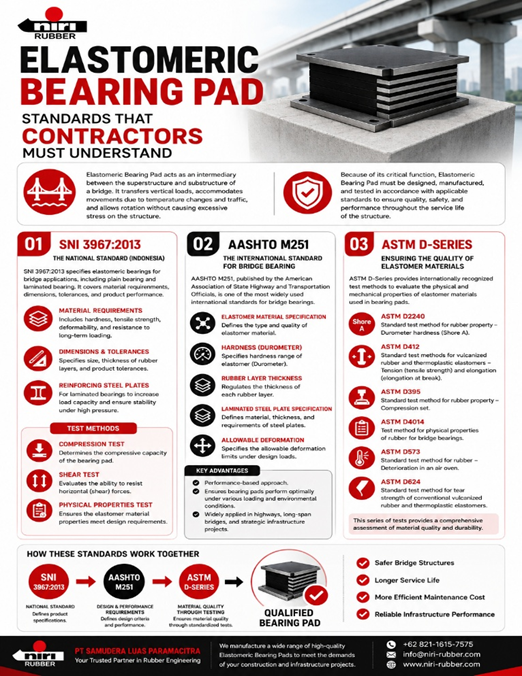
Because of their critical role, elastomeric bearing pads must be designed, manufactured, and tested in accordance with recognized standards. In Indonesia, bridge bearing pads are commonly specified in accordance with SNI 3967:2013, while some projects may also reference international standards such as AASHTO M251 and various ASTM testing standards. Together, these standards help ensure the quality, safety, and long-term performance of bearing pads throughout the service life of a structure.
SNI 3967:2013
SNI 3967:2013 is the Indonesian national standard that specifies elastomeric bearings for bridge applications, including both plain bearings and laminated bearings. The standard covers material requirements, dimensions, tolerances, and product performance criteria.
It also defines key elastomer properties such as hardness, tensile strength, deformation characteristics, and resistance to long-term loading. For laminated bearings, the standard regulates the use of reinforcing steel plates to improve load-bearing capacity and structural stability. In addition, SNI establishes testing procedures, including compression tests, shear tests, and physical property evaluations to ensure that bearing pads meet bridge design requirements.
AASHTO M251
Published by the American Association of State Highway and Transportation Officials (AASHTO), AASHTO M251 is one of the most widely recognized international standards for elastomeric bridge bearings.
The standard provides detailed requirements for elastomer materials, hardness (durometer), rubber layer thickness, laminated steel plate specifications, and allowable deformation limits. The specification establishes material, dimensional, and fabrication requirements intended to ensure reliable performance under service conditions. As a result, AASHTO M251 is widely used in highway projects, long-span bridges, and other critical infrastructure developments.
ASTM D-Series
The ASTM D-Series focuses on testing the quality of elastomer materials used in bearing pad manufacturing. Some of the most commonly referenced standards include:
- ASTM D2240 – Measures material hardness (Shore A).
- ASTM D412 – Evaluates tensile strength and elongation at break.
- ASTM D395 – Measures compression set, which indicates the material’s ability to recover its original shape after being subjected to prolonged compression.
Additional standards commonly used include ASTM D4014 for evaluating the physical properties of bridge elastomeric bearings, ASTM D573 for accelerated aging resistance testing, and ASTM D624 for tear resistance testing. Together, these tests provide a comprehensive assessment of the quality and durability of elastomer materials.
In practice, SNI 3967:2013, AASHTO M251, and ASTM D-Series standards complement one another. SNI serves as the national product specification standard, AASHTO establishes design and performance requirements, and ASTM ensures material quality through standardized testing methods.
PT Samudera Luas Paramacitra manufactures elastomeric bearing pads designed to meet project-specific requirements and applicable standards. For more information or to discuss the most suitable solution for your project, please contact us at +62 821-1615-7575 or email info@niri-rubber.com.


