Bollards play an important role in maintaining vessel safety during mooring, berthing, and cargo loading or unloading operations at port facilities. In operation, bollards are subjected to large tensile forces from mooring lines, which are dynamic in nature due to waves, currents, wind, vessel movement, and tidal changes. Because they continuously withstand heavy loads, bollards must be manufactured from the right material.
Bollard materials must have strong mechanical characteristics to prevent cracking or structural failure that could cause mooring lines to detach. In addition, bollards must be resistant to seawater corrosion and capable of long-term operation.
On the other hand, improper material selection can lead to damage to port facilities, increased maintenance costs, and even operational safety risks.
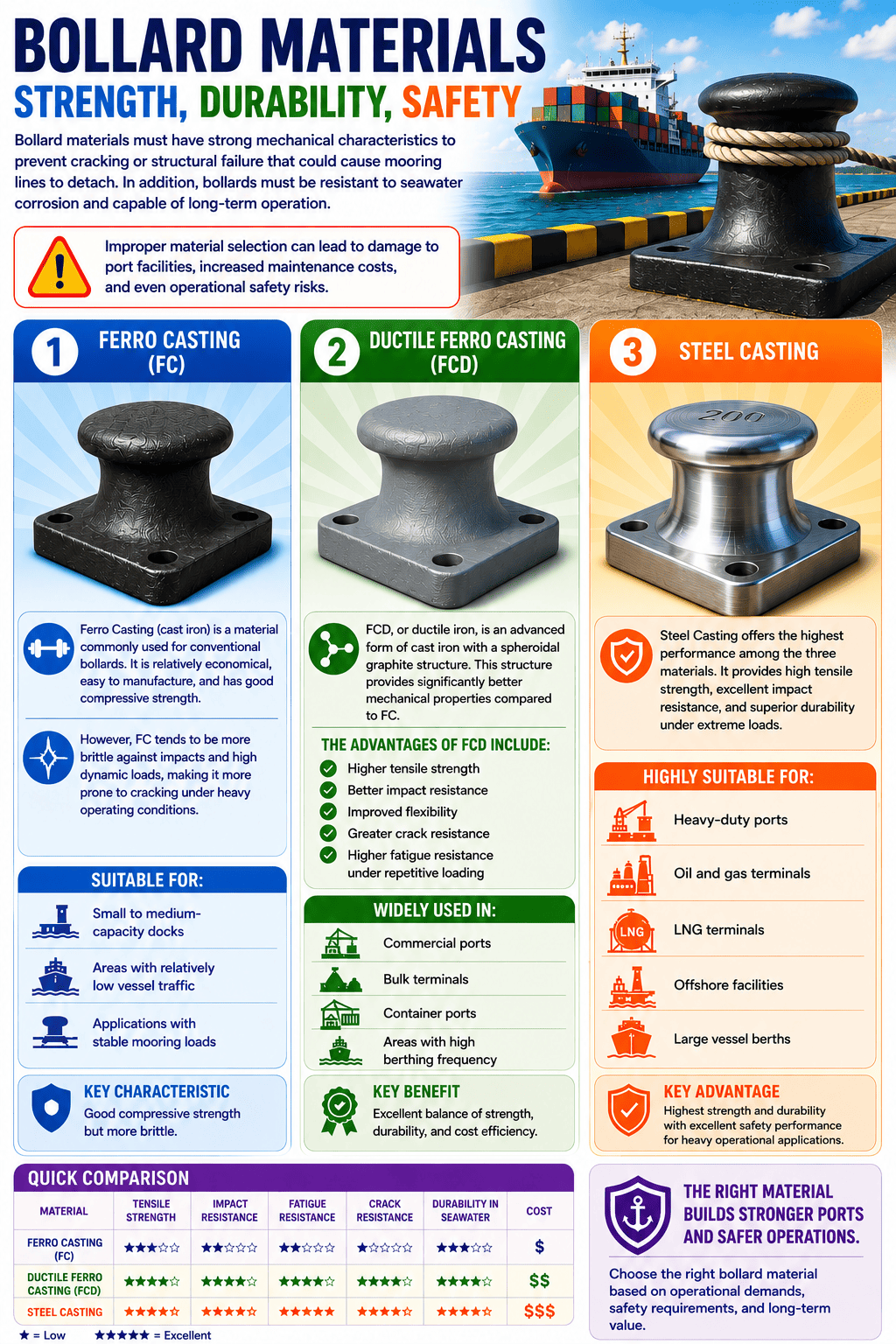
There are three commonly used bollard materials: Ferro Casting (FC), Ductile Ferro Casting (FCD), and Steel Casting.
1. Ferro Casting (FC)
Ferro Casting (cast iron) is a material commonly used for conventional bollards. It is relatively economical, easy to manufacture, and has good compressive strength. However, FC tends to be more brittle against impacts and high dynamic loads, making it more prone to cracking under heavy operating conditions.
FC material is suitable for:
- small to medium-capacity docks,
- areas with relatively low vessel traffic,
- applications with stable mooring loads.
2. Ductile Ferro Casting (FCD)
FCD, or ductile iron, is an advanced form of cast iron with a spheroidal graphite structure. This structure provides significantly better mechanical properties compared to FC.
The advantages of FCD include:
- higher tensile strength,
- better impact resistance,
- improved flexibility,
- greater crack resistance,
- higher fatigue resistance under repetitive loading.
Due to these characteristics, FCD is widely used in:
- commercial ports,
- bulk terminals,
- container ports,
- areas with high berthing frequency.
In many modern projects, FCD has become a popular choice because it offers an excellent balance of strength, durability, and cost efficiency.
3. Steel Casting
Steel Casting offers the highest performance among the three materials. It provides high tensile strength, excellent impact resistance, and superior durability under extreme loads.
Steel Casting is highly suitable for:
- heavy-duty ports,
- oil and gas terminals,
- LNG terminals,
- offshore facilities,
- large vessel berths.
Although it has a higher production cost, Steel Casting delivers excellent safety performance and long service life for heavy operational applications.
PT Samudera Luas Paramacitra manufactures port bollards tailored to your project requirements. For bollard inquiries and consultation regarding suitable material specifications, please contact our customer care hotline at (+62) 823 2018 9998 or email admin@niri-rubber.com.


